Saturday, March 8, 2014

Slithering leaf mates: snake and skink

There is still no sunshine but on Saturday the temperature was approaching 60 degrees so it was a good day to spend a couple of hours raking leaves and pulling weeds before it started raining again.

However when you start raking, you disturb creatures under the leaf litter.

First I found this tail sticking out when I swept away an inch of crunchy leaves.

Exposed tail.

The tail belonged to a Rough Earth Snake that didn't want me to look at its face. 


A few minutes later I uncovered a skink that wasn't as pliant as the snake. It wanted to slither away from me as quickly as possible.

Let's admire those stripes on this Little Brown Skink.


Cute legs.

These little lizards are garden friends. According to the Galveston County Master Gardeners:

Generally skinks are no longer than 8 inches. Most skink species have short legs that are well-formed and a few have no legs at all. They often look like a snake crawling about. Skinks are very beneficial to the garden because their prey includes grasshoppers, snails, slugs, cockroaches and even small mice. Most skinks are active during the day and prefer hanging out on the ground rather than climbing trees. Some skinks like to burrow.

Even though you may not be well-acquainted with, or even aware of, skinks; tribes of these sleek-bodied mini-hunters are hopefully stalking pests in your garden as you read this. They help to maintain a natural balance and protect your plants.

I tossed the snake and the skink under the deck where I also throw a lot of leaves when I'm feeling lazy. There should be plenty of good hiding places under there.

Thursday, March 6, 2014

Greetings from the Sheldon Lake freshwater coastal prairie wetland

Marissa Sipocz, Urban Wetlands Program Team Leader, wades out to point out some wetland plants.
I reconnected with some buddies from the 2013 Galveston Bay Area Master Naturalist class at Sheldon Lake State Park March 6.

The new class was learning about wetlands, and I audited their sessions after I had fulfilled my greeter duties.

It looks kind of brown, but we could see green Pickerelweed (Pontederia cordata) peeking up along the boardwalk. It should be a colorful hike this spring

Saturday, February 22, 2014

Checking out a Florida beach

Some sights from a quick trip to Florida.

Dania Beach, which becomes Hollywood Beach if you keep walking, gets more crowded around midday.       

The bold Royal Tern was on beach patrol.


There were several Portuguese Man o' War along the water line before the beach cleaner rolled through.

When I find a rock with a whole all the way through, I put it in my pocket.
At Anne Kolb Nature Center at West Lake Park, the Mangrove swamp is the star.  
The Tree Crabs we spotted looked like big ticks.
A view from the tower.
Along the boardwalk there are hundreds of Fiddler crab holes.
Sometimes in the distance you can see White Ibis feasting on the crabs.

Tuesday, January 28, 2014

Before the sleet started, the bird feeder was a hot spot

Stuck inside on his dreary day, I found the bird feeder to be quite entertaining this morning. I have been sitting at the window taking pictures.

While the Goldfinches were competing for space at the feeders, a group of Cedar Waxings arrived to check out the pond. They were so pretty.

Some fat Cardinals (there are at least three) came in for a snack. And a Tufted Titmouse joined the Goldfinches for a morning meal.


They flew from the trees to the pond a few times and then left.

A Goldfinch waiting atop a ladder for its turn at the feeder gives me a look that I interpret as: "Human, you need to add more feeders.

Fat cardinal surveys the buffet.
Did someone say Titmouse? Wink, wink. Nudge, nudge.
After the noontime sleet stopped, I added more food, and the party started again.
A large afternoon guest: White-wing Dove
At least three Bluejays appeared. They zoom in, grab morsels and jolt away like amateur shoplifters.

Friday, January 17, 2014

January bird count: Great Horned Owl watches us watching it

There is a Great Horned Owl nesting along the main road into Baytown Nature Center.

We saw it peeping out of its nest as we started the January bird count Thursday. I hope to see some owlets in the coming weeks.

Dedicated David H. led the bird count group and recorded 64 species.

We were trudging along near the end of a 4.5-hour bird search when an opossum came out of the brush and approached the trail. It took a look at me and scurried away.

Not a bird.
The list 
    
12   Gadwall
3    Mallard (Domestic type)
8    Northern Pintail
30  Green-winged Teal
8    Hooded Merganser
2    Pied-billed Grebe
6    Neotropic Cormorant
15  Double-crested Cormorant
28  American White Pelican
9    Brown Pelican
6    Great Blue Heron
11   Great Egret
5    Snowy Egret
3    White Ibis
4    Roseate Spoonbill
5    Black Vulture
3    Turkey Vulture
1    Osprey
2    Red-tailed Hawk
1    Clapper Rail
29  Killdeer
5    Spotted Sandpiper
9    Greater Yellowlegs
5    Lesser Yellowlegs
22  Least Sandpiper
1    Wilson's Snipe
150  Laughing Gull
6    Ring-billed Gull
4    Herring Gull
1    Caspian Tern
35  White-winged Dove
5    Mourning Dove
1    Great Horned Owl
5    Belted Kingfisher
3    Red-bellied Woodpecker
2    Downy Woodpecker
1    American Kestrel
2    Eastern Phoebe
2    Loggerhead Shrike
4    Blue Jay
7    Carolina Wren
2    Blue-gray Gnatcatcher
8    Ruby-crowned Kinglet
2    Eastern Bluebird
1    Hermit Thrush
1    American Robin
3    Brown Thrasher
14   Northern Mockingbird
15   European Starling
110  Cedar Waxwing
4    Orange-crowned Warbler
1    Pine Warbler
45   Yellow-rumped Warbler (Myrtle)
1    Savannah Sparrow
3    Swamp Sparrow
3    White-throated Sparrow
1    Harris's Sparrow
10  White-crowned Sparrow
7    Northern Cardinal
19  Red-winged Blackbird
5    Great-tailed Grackle
30  Brown-headed Cowbird
2    American Goldfinch
3    House Sparrow
1    Tufted Titmouse


Friday, January 10, 2014

That bright spot: Do you call it a ladybug or lady beetle?

Do you call it a ladybug or lady beetle.
 
This colorful ladybug was a standout in the Baytown Nature Center butterfly garden on the misty, gray day with temps approaching 70 degrees.
 
Looks like an Asian labybug.
 
Alas it not a nine-spotted ladybug, which is the subject of the Lost Ladybug Project.

Friday, January 3, 2014

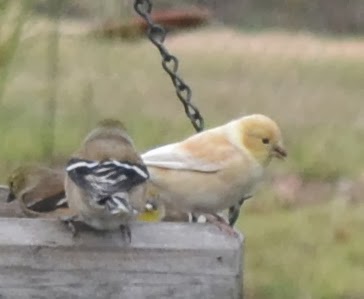
Albino goldfinch pays a visit, I think

A yellow standout among the American Goldfinches.

When the light yellow bird joined the American Goldfinches at my feeders, I used my phone to snap a couple of pics.

I knew I could bother David H. with another "name that bird" question, but I wanted to figure it out myself.

It took me a couple of hours, but I decided it was an albino goldfinch.

Or looks likes a case of partial leucism.

Did I get the ID right?

The yellow visitor was hungry.

I hope it comes back, and I can get better photos.