Showing posts with label sheldon lake. Show all posts

Wednesday, August 17, 2016

When it rains, you get a seed day indoors

Break open the Erect Baptisia (Baptisia sphaerocarpa) pods to find the seeds.
 When it is too rainy to go outdoors, volunteers at Sheldon Lake State Park & Environmental Learning Center clean seeds. A no-sweat workday.

Sometimes you need a hammer to get the seed pods open.
A bucket of seed pods will be reduced to about two cups of seeds.
If you sneeze while separating the Splitbeard Bluestem seed heads, all your work will fly away.
Seed work gives you time to chat. We managed to stay away from the topic of politics.

Sunday, November 15, 2015

On the look out for river otters

Here is something I wrote for the Galveston Bay Area Master Naturalist newsletter.
.......

Texas Parks and Wildlife Department photo of a river otter.


Spotting a river otter in the wild is something special.
Mark Kramer remembers the first time he saw a river otter at Armand Bayou Nature Center.

“I began paddling the bayou in my youth in 1972, so when my first otter sighting occurred in 1995, it meant a great deal to me,” Kramer wrote in reply to GBAC-MN email questions.

“I happened to be near the water’s edge throwing a cast net when I heard a call/vocalization that I didn't recognize. I lay on my belly at the edge of the water waiting for the animals to swim past — a mother with three pups! 

“I was so moved that I wrote an article in the ABNC newsletter about it,” he said. “They are simply the most charismatic animals on the refuge.”
  
ABNC stewardship coordinator Kramer, who is on the water a lot, said he sees river otters eight to 10 times a year. He was paddling in his kayak for his last sighting.

Marissa Sipocz, who has been leading wetland restoration at Sheldon Lake State Park for the past 13 years, was excited to see a river otter a few months ago crossing Park Road 138. She has seen otters only two or three times previously.

“I was totally shocked when I watched him hop across the road, thinking: ‘Oh my goodness, that's an otter! How cool! So adorable!!’ "

Sipocz and Kramer believe the sightings indicate a healthy habitat with abundant food and a quiet place to relax and raise their young.

Texas Parks and Wildlife Department’s river otter specialist agrees. Gary Calkins, district leader for Piney Woods ecological area, has been on river otter watch for 12 years and collecting sightings the past nine years for a study.

Our river otters (Lutra canadensis) are indicator species and opportunistic hunters, he said. They eat fish but especially like crawfish, frogs, tadpoles and blue crabs, which are sensitive to pollutants. They often feed at dawn or dusk.

River otters generally live in hollows near water. They can live eight to nine years in the wild. There are one to six pups in a litter.

Their slender bodies with short necks and legs covered with glossy dark brown fur help make them acrobats in the water. They can hold their breath up to eight minutes underwater. Members of the weasel family, they weigh 11 to 30 pounds.

They live in fresh water but will hunt in brackish water and along the coast. Calkins notes that sightings have been reported at the Kemah Boardwalk.

River otters make an impression when spotted because while they are secretive, they can appear playful and will interact with people up to a point, Calkins said.

The good news is that TPWD research shows the web-footed mammals have been spreading rapidly back into their historical range in Central Texas since the 1990s. The numbers had been down due to trapping and habitat loss. 

Calkins has recorded sightings in the San Antonio and Wichita Falls areas, well beyond the Eastern corner of the state where many of the state’s otters reside.

However Calkins says it is impossible to get accurate population numbers because otters are elusive. Biologists collect information from legal trappers, indicator surveys, road kill and signs of tracks and scatter.

Personally Calkins has seen only four rivers otters in the wild. His first sighting was in the Jasper area. “I was pretty jazzed,” he said.

Sharon Schmalz and staffers at the Wildlife Center ofTexas get up-close with two to five river otters every year. 

They bite, warns Schmalz, WCT executive director.

This year two young ones have arrived at WCT for rehabilitation. Each case is special, she said.

One of the river otters was found by someone who kept it for eight weeks before taking it to WCT. “At that point he was very underweight and severely malnourished and in poor condition overall. His case was a testament to why we ask people to bring animals as soon as they can for the best care possible,” Schmalz said.

The second one was found orphaned on a beach by a Good Samaritan who took it to the center..

Both animals went through WCT rehab and were transferred to a rehabilitator near Tyler who will care for them about a year before releasing them into a habitat on her property.

River otters are little contradictions, Schmalz said.

“They are very intelligent, playful, and social; all qualities humans possess. So it's natural for those of us working with them to respond to those qualities,” Schmalz said. “However otters are by no means tame.

“Mother otters discipline their young by nipping at them and siblings nip at each other when playing. So when handling them they have a real tendency to bite a lot. And they have very sharp teeth and strong jaws.

“They have these adorable faces and personalities, but their demeanor and energy level make them one of our more challenging patients. But of course, our staff and dedicated volunteers love every minute.”


Tuesday, August 25, 2015

A little snake takes a peak at us


We know there are critters in the prairie restoration team's stacks of pots at Sheldon Lake State Park. Ants, frogs, spiders, snakes.

I usually give the stack a little kick before I grab some empties.

A couple of weeks ago our noise persuaded a big brownish snake to leave the pots stack and head toward the brush. Some thought it was a water moccasin, but we didn't get close enough to confirm.

Today we got the attention of little Ribbonsnake. We didn't seem to scare it. The snake just watched us.

The snake let me get close enough to take this pic with my iPhone.

And then it waited for us to leave.

Wednesday, August 12, 2015

Basking bullfrogs have an audience

Bullfrogs hanging out near the aquatics collection lab.

Bullfrogs and fat bullfrog tadpoles are making their home in the ponds at Sheldon Lake State Park and Environmental Learning Center.

But the bullfrogs need to watch who is watching them. In addition to humans, snakes and birds are admiring the jumpers.

This snake was swimming along the bank when frogs splashed into the water.

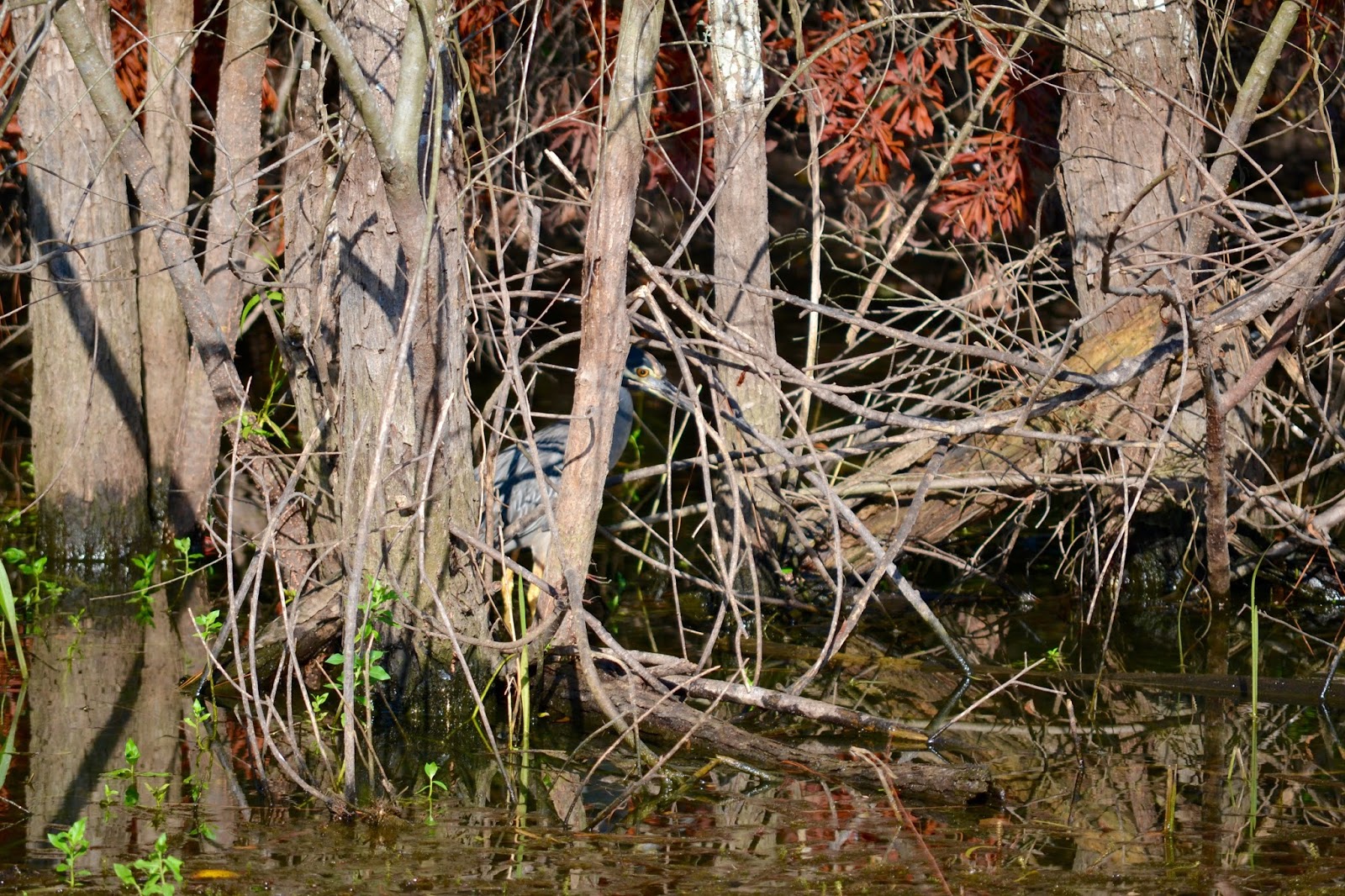
Hiding in the branches along the shoreline near a couple a frogs basking in the sun, a heron was in stalker mode.

Wednesday, March 25, 2015

Sharing the walkway with a little snake


Little brown snake why are you on the sidewalk?

The concrete maybe warmer than the flowerbeds all around, but you are in danger of being stepped on or scooped up by a predator.

So quit flicking your tongue at us and get moving. Be safe!


Wednesday, September 17, 2014

How long would it take you to make 1,000 seedballs?

Pinching off a bit of clay/soil/seed mixture, the students rolled grape-sized seedballs between their hands.

Many hands make quick work of two buckets of seedball mixture.

It took 40 sixth-graders about 90 minutes to produce more than 1,000 seedballs to toss into the prairie/wetlands at Sheldon Lake.

Making seedballs to distribute a coastal prairie seed mix follows a farming method popularized in Japan. After the dried seedballs are scattered, all that is needed is a good rain to dissolve the seedballs and give the seeds a chance to germinate.

The students also helped with sprigging and potting. On this rainy day, getting muddy was part of the learning process.
This big seedball will make about about 75 little ones.
When you have a broken arm, you perfect a one-handed technique for rolling seedballs.

Friday, August 1, 2014

Put on your boots, hibiscus seed is ready to collect

The brown pods are open so we take a few to get the seeds.

Collecting hibiscus seed pods reminds me a little of picking cotton, which my family knows a bit about.

The hibiscus seeds were collected around pond 5 at Sheldon Lake for distribution around other ponds.

The cotton farm I grew up on was in West Texas.

That's me (below) in the red tennies picking cotton.

I never filled a tow sack. Most of the cotton was collected with a stripper.

Sunday, July 20, 2014

Tree frog rides along for change of address

 A feisty tree frog came in from a nearby ditch with the clumps of grasses to be sprigged and relocated in ponds at Sheldon Lake.

 This one was released in a pond near the environmental learning center at Sheldon Lake. Maybe you will see it during your next visit.

Sometimes you are surprised by what you find in the smelly, muddy buckets of grasses. Usually it is a pleasant surprise.


Wednesday, June 18, 2014

Curious snake surveys the action

A little snake peeked up between the pots of Spider Lily in the grow-out ponds at Sheldon Lake as we prepared for a Wetlands Wednesday workday.

It was so hot -- around 90 -- that after an hour of pulling the cart and emptying pots of dirt, I was a red-faced sweaty mess. I blame my heat-intolerance on my blood pressure meds not my aging body.

Anyway I spent the next hour indoors working with the seed crew in air-conditioned comfort.


Thursday, May 8, 2014

Salute: Red Admiral butterfly shows its colors

Today the Houston area is expecting some much-needed rain.

However Thursday at Sheldon Lake this Red Admiral butterfly was happy to find a damp spot in a replanted parking lot ditch.

The Red Admiral was just where you would expect to find it because the butterflies prefer moist habitats such as lakes, marshes and drainage ditches.

The Red Admiral likes to spend the winter in South Texas, according to Texas Parks and Wildlife Department.

Red Admirals like to feed on nettles. They also like milkweed, mint, alfalfa, aster, phlox, coreopsis and clove. For nectar they like tree sap and rotten fruit.

Wednesday, April 23, 2014

Relocating blue iris and mudbugs at Sheldon Lake


While collecting 492 Iris virginica (I was the counter) plus miscellaneous plants from an overgrown parking lot patch at Sheldon Lake, we disturbed a few crawfish.

They didn't like being picked up, but they were carefully relocated to a plant grow-out pond.

Ninety-two iris sprigs went back into the same mud bed. The rest will be planted near a Sheldon pond next week with the help of high school volunteers.

I would suggest the students wear shorts and sunblock.

Today in the sunshine with the temperature around 80, I was a smelly, sweaty mess after about 15 minutes. And I wasn't even one of the volunteers wielding a sharp shooter shovel.

Thursday, April 3, 2014

Treat. Yo. Self: new gloves edition

Nothing like getting a new pair of gloves for outdoor work.

These are the gloves used by many on the Wetlands Team working at Sheldon Lake. As an aspiring team member, I traded in my patched, stiff gloves for some orange newbies.


Wednesday, March 12, 2014

Bullfrog make a surprise guest appearance

Today's chore of removing grasses from the pots of Lizard's Tail plants got a jolt of excitement when a Bullfrog jumped out of a pot on the work table at Sheldon Lake.

Was I the one who yelped when the frog made its escape leap?

No. But it wasn't in the pot I was working on. 


Pretty eyes.

One more pic before returning it to the grow-out pond.

The pots on the left have been cleaned. Only half a jillion more left for the Welands Team to complete. On this blustery day with temps in the upper 50s, we worked only on the Lizard's Tail.

In other amphibian encounters: On Monday I uncovered a hole and Gulf Coast toad hopped out. I guess it thought I was knocking.

Thursday, March 6, 2014

Greetings from the Sheldon Lake freshwater coastal prairie wetland

Marissa Sipocz, Urban Wetlands Program Team Leader, wades out to point out some wetland plants.
I reconnected with some buddies from the 2013 Galveston Bay Area Master Naturalist class at Sheldon Lake State Park March 6.

The new class was learning about wetlands, and I audited their sessions after I had fulfilled my greeter duties.

It looks kind of brown, but we could see green Pickerelweed (Pontederia cordata) peeking up along the boardwalk. It should be a colorful hike this spring

Friday, December 20, 2013

Spending the last day of fall at Sheldon Lake


Before the bus arrived, I walked out on a boardwalk for a look about.

The Friday before Christmas was the last day of the year for planting with students and Wetlands Restoration Team volunteers at Sheldon Lake State Park.


Teens in rubber boots planted two species of Cordgrass on the outer banks of Pond Anhinga, which is off a road that is closed to the public. 

On Wednesday I had helped the wetlands team get 1,400 sprigs ready for the student volunteers, but this was the first time I had been part of a planting detail. I am a newbie volunteer who joined in mid November.

I managed to stay on my feet while wading in the muck in my three-sizes-too-big rubber boots that I bought at a garage sale. Buddy Diane H. showed me how to use the dibble, and we made our way around the pond.

Most of the kids were veterans planters who had been on a planting mission a month earlier. When one of the coordinators asked who were inexperienced, I raised my hand along with the girl in skirt. And she turned out to be an enthusiastic worker who said she would like to work at Sheldon Lake. When a ranger joked that she could come back early Saturday morning to clean the rubber boots, she just laughed and waved.

In 90 minutes the sprigs had new homes along the pond thanks to the teens.

But there are no photos because I was afraid I would make a splash down so I left my phone in a safe, dry place.

Wednesday, December 11, 2013

It's not poop, it is scat

Getting middle-schoolers to use the word "scat" can be a challenge on a hike.

During a quick walk along trails at Sheldon Lake in 40-degree weather we encountered several piles of scat. There are always ewwws or giggles.

The scat comprised mostly of seeds probably were left by raccoons or possums.

Then there was scat with fur and seeds. An omnivore was here, it was concluded. There was discussion about a coyote as a possible culprit.

"It scatted it out," a kid announced.


Friday, November 22, 2013

Look closer for the Juncus scirpoides seeds

The Wetland Restoration Team working indoors Wednesday started with three lunch-size paper bags filled with stems from Juncus scirpoides aka Needlepod rush.

The goal was to collect the seeds.  That's when I learned the seeds are about the size of a period . . .

No sneezing allowed while working on this chore.

We ended up with about two tablespoons of seeds. Success!

The dried capsules . . .

. . . are deconstrusted over a white paper plate.

With a small brush, the seeds are swished in a collection sieve.

What you see here is mostly litter. An extreme close-up would show the seeds, which are tiny, uniform-size dots.

Wednesday, November 13, 2013

Working with seeds gives you a warm feeling


Picking out the seeds can be tedious.

Woke up to to coldest morning this fall -- around 37 degrees -- to go to my first volunteer day with the Wetlands Team at Sheldon Lake. 

I opted to stay indoors to help deconstruct dried Indian Plantains, which were collected along Beltway 8 for their seeds.

One group braved the cold to take school kids to plant at the water's edge. Brrr.

The kids that wanted to stay indoors made seeds balls.

Maybe next week I'll get wet. -- Lana b

Thursday, August 29, 2013

Sedges have edges and violets are blue

During the first day of Wetland Plant Identification class we learned a poem.
Sedges have edges
Rushes are round
Grasses are hollow from node to the ground.

The rhyme is supposed to help me get a grip on the distinctions among Cyperaceae, Juncaceae and Poaceae, with emphasis on the plants used by the restoration team at Sheldon Lake. 

Everything that I learned in class each Wednesday was a jumble two hours after I got home. So I was pleased that at least I remembered the poem.

Then I learned there are different versions. Oh, no!

This one is in our notebooks:
Sedges have edges
Rushes are round
Grasses have joints, when the cops aren't around.

A simple search turned up:
Sedges have edges
Rushes are round
Grasses have nodes where leaves are found.

Sedges have edges
Rushes are round
Grasses have joints that your friends pass around.
Sedges have edges and other things. White-topped sedge: Rhynchospora colorata / Dichromena colorata

Sedges have edges
Rushes are round
Grasses have joints where elbows are found

What the what?

Here's my version:

Sedges have edges
Rushes are round
Grasses have nodes, moron.
- Lana b.

Wednesday, August 21, 2013

Gator with a taste for cats


The suspect.

This alligator is an accused cat killer, and it doesn't want you to find the evidence.

About two months ago the alligator, which is close to 5 feet long, moved into the small pond that is kept filled at Texas Parks & Wildlife Department's State Park Region 4 headquarters.

It is unusual for an alligator to move into such a small pond, but not unusual to see stray cats or dogs on the property, said Kelly the warden.

Recently a dead cat was spotted in the pond. There is speculation that the gator killed the cat and has stashed the decaying cat body underwater near the walkway for later meals. The cat was too big for the alligator to eat whole so it is munching on bits of the cat as the carcass deteriorates.

I want to believe it.

During a wetlands plants class, about 20 of us were standing on the walkway when the alligator surfaced under a couple of duck decoys to hiss at us.

When I went out after class to check on the alligator, I couldn't see it. But while I was chatting with a couple of wardens and another classmate, the gator crossed the pond to return to the same spot.

It lifted its head and gave a hiss.

I think that's gator talk for: "Get away from my dead cat." Or, maybe: "I would like to bite off your fingers and hide them down here with my dead cat." -- Lana b.

That's close enough.

Wetlands Plant Identification class instructor Andy points out some live specimens in a pond inhabited by a couple of duck decoys and a very live alligator.